Pipelines
Every step, and where the model gets a say
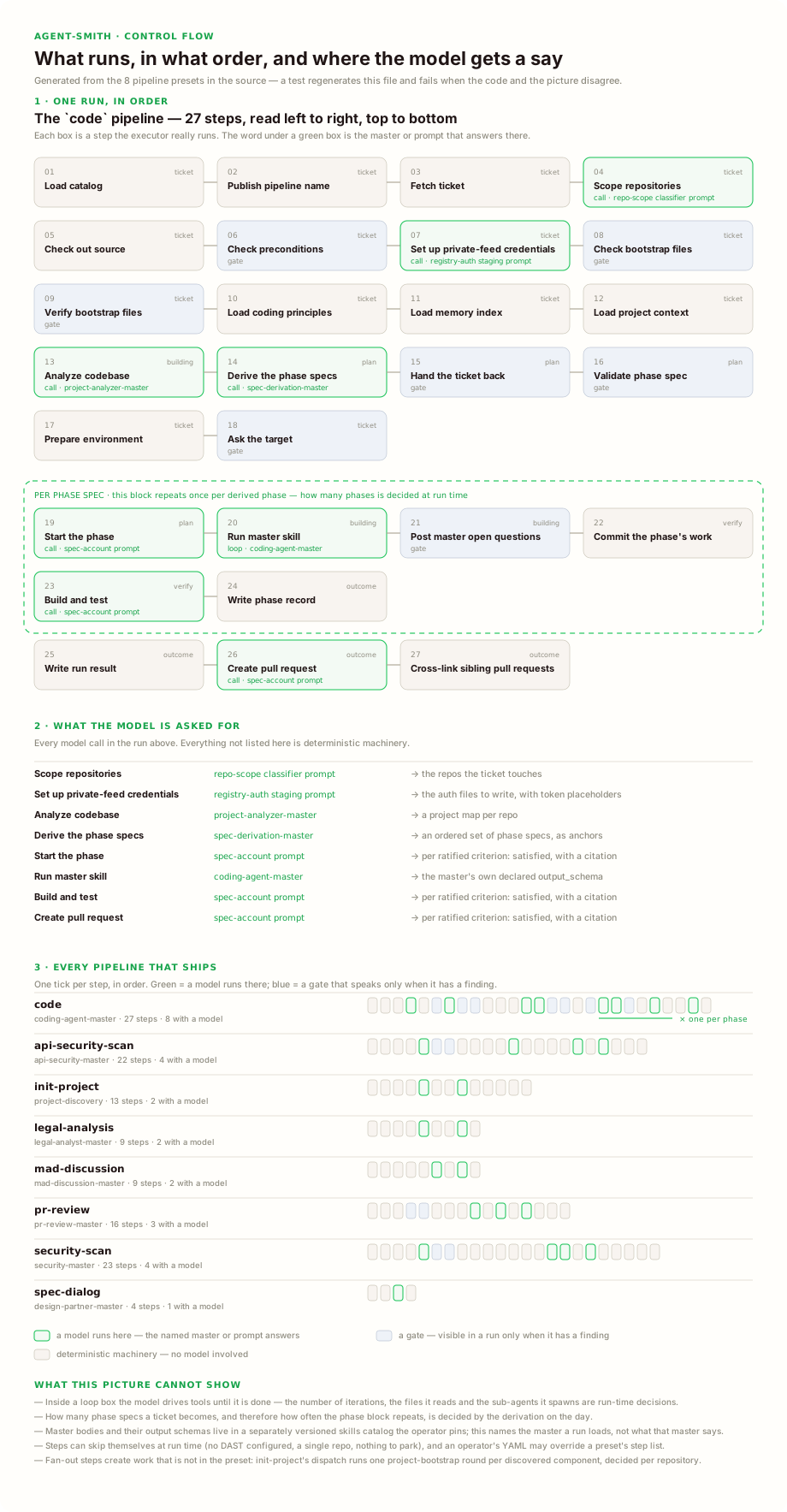
This one is generated from the pipeline definitions in the source, by a test that fails when the code and the picture disagree. So it is what the orchestrator really executes, in that order.
Each box is one step. Green means a model runs there, and it names which one and what it is asked for. Grey is plain machinery with no model involved. Blue is a gate that speaks up only when it has something to report. The dashed frame is the part that repeats once per derived phase, and how many phases a ticket becomes is decided during the run.
Which surface reads this
The YAML on this page is the file format. On a server the same values live in the database and are edited in the Config studio; the CLI reads them from agentsmith.yml. agent-smith config import moves one into the other. See Where configuration lives.
Agent Smith ships with a dozen pipeline presets — pre-built sequences of command handlers that cover the most common AI orchestration workflows.
Pipeline Overview
| Pipeline | Trigger | What It Does |
|---|---|---|
| fix-bug | agent-smith fix --ticket N --project P / label |
Ticket → branch → code → verified green → PR |
| fix-no-test | label / pipeline: config |
Like fix-bug for repos without a test suite |
| add-feature | agent-smith feature --ticket N --project P / label |
fix-bug + generated tests + docs |
| pr-review | label / PR comment | Reviews a PR diff, posts line-anchored findings as comments |
| security-scan | agent-smith security-scan --agent A / label |
Multi-role code security review with SARIF output |
| api-security-scan | agent-smith api-scan --agent A --swagger … --target … / label |
Nuclei + Spectral + AI specialist panel on live APIs |
| legal-analysis | agent-smith legal --source F --project P |
Contract review with 5 legal specialist roles |
| mad-discussion | agent-smith mad --ticket N --project P / label |
Multi-agent design discussion with convergence |
| skill-manager | label / chat | Author, lint, and validate skills |
| autonomous | agent-smith autonomous --project P |
Observe project, write tickets autonomously |
| init-project | agent-smith init --project P / agent-smith:init label |
Bootstrap .agentsmith/ in every repo of a project |
| spec-dialog / phase-execution | chat thread / phase label |
The conversational design partner and the phase runner — see Spec dialogue |
All pipeline commands support --dry-run to preview the execution plan without running it. Utility commands (compile-wiki, security-trend) also support --dry-run.
Two init-project behaviors worth knowing: re-running init preserves your manual context.yaml edits and only backfills missing auto-detectable fields, and an init run that produces no changes closes its ticket cleanly ("already bootstrapped") instead of leaving the poller looping on it. Re-init by moving the ticket back into a trigger status.
How Pipelines Work
Every pipeline is an ordered list of commands. Each command has a matching handler that does the actual work. Commands share a PipelineContext — a key-value store that flows data between steps.
Pipeline: fix-bug
├── LoadCatalog            → loads the skills catalog (embedded by default)
├── FetchTicket            → reads ticket + comments + attachments from the tracker
├── ScopeRepos             → narrows the run to the repos the ticket touches
├── CheckoutSource         → clones repos, creates branches
├── SetupRegistryAuth      → pre-stages private-feed credentials
├── BootstrapCheck/Gate    → aborts early if the repo was never initialized
├── LoadCodingPrinciples   → loads coding standards from repo
├── LoadContext            → loads .agentsmith/context.yaml
├── AnalyzeCode            → scout agent maps relevant files
├── NegotiateExpectation   → ratified acceptance contract (the "Soll" block)
├── EnsurePrerequisites    → installs dependencies
├── GeneratePlan           → AI generates implementation plan
├── PlanOpenQuestions      → parks the ticket if clarification is needed
├── Approval               → waits for human OK (or runs headless)
├── AgenticMaster          → the coding master writes code + runs the tests
├── WriteRunResult         → writes result.md with cost/token data
├── CommitAndPR            → commits, pushes, opens PR (secret-scanned)
└── PrCrossLink            → cross-links sibling PRs (multi-repo)
Dynamic Pipeline Expansion
Some commands insert follow-up steps at runtime. The Triage step inspects the problem and inserts SkillRound commands for each specialist role it selects. The ConvergenceCheck step evaluates whether all roles have met their convergence criteria — if not, it inserts another round.
Static pipeline:
  ... → Triage → ConvergenceCheck → CompileDiscussion → ...

After Triage expands:
  ... → Triage → SkillRound(vuln-analyst, r1) → SkillRound(auth-reviewer, r1)
      → ConvergenceCheck → CompileDiscussion → ...

After ConvergenceCheck finds objections:
  ... → ConvergenceCheck → SkillRound(auth-reviewer, r2)
      → ConvergenceCheck → CompileDiscussion → ...
Custom Pipelines
You can define custom pipelines in agentsmith.yml:
pipelines:
  my-custom-pipeline:
    commands:
      - FetchTicketCommand
      - CheckoutSourceCommand
      - BootstrapProjectCommand
      - AgenticExecuteCommand
      - CommitAndPRCommand
Then reference it in your project config:
Pipeline Types
Since Phase 64, Agent Smith classifies every pipeline into one of three orchestration types. The type determines how skills are selected, how they communicate, and whether convergence rounds apply.
| Type | Triage | Skill Runs | Handoffs | Convergence |
|---|---|---|---|---|
| discussion | LLM selects skills | Multiple rounds possible | Free-text accumulation | Yes -- rounds until consensus |
| structured | Deterministic graph (SkillGraphBuilder) |
Single call per skill | Typed JSON (SkillOutputs) |
No -- skipped |
| hierarchical | Deterministic graph (SkillGraphBuilder) |
Lead then contributors then gates | Typed JSON | No -- gate veto instead |
Discussion pipelines
mad-discussion, legal-analysis. LLM-based triage selects relevant skills. Skills run in rounds with free-text accumulation. ConvergenceCheck evaluates whether all skills agree; if not, objecting skills re-run until consensus or the max round limit. Skills without an orchestration block default to contributor role in discussion mode.
Structured pipelines
security-scan, api-security-scan. SkillGraphBuilder builds a deterministic execution graph from runs_after/runs_before declarations in skill metadata. No LLM triage. Skills are topologically sorted into stages: contributors (parallel, category-sliced) run first, then a gate (e.g., false-positive-filter) that can veto findings, then an executor. Each skill runs exactly once with typed JSON handoffs. The gate produces typed List<Finding> output that flows directly to DeliverFindings, bypassing raw text extraction. This achieves approximately 80% token reduction compared to discussion mode.
Hierarchical pipelines
fix-bug, add-feature, fix-no-test. A lead skill drives the workflow, delegating to contributor skills and validating through gate skills. The execution graph is deterministic (built by SkillGraphBuilder), but the lead has authority to direct contributors. No convergence rounds -- gates provide pass/fail verdicts.
Context keys
The pipeline type is stored in PipelineContext under the PipelineType key. Additional context keys introduced in Phase 64:
| Key | Type | Description |
|---|---|---|
PipelineType |
string |
discussion, structured, or hierarchical |
SkillGraph |
ExecutionGraph |
The topologically sorted skill graph |
SkillOutputs |
Dictionary<string, object> |
Typed outputs from each skill, keyed by skill name |
Next Steps
- Fix Bug / Add Feature — the coding pipelines
- Security Scan — code security review
- API Scan — live API scanning
- Legal Analysis — contract review
- MAD Discussion — multi-agent design debate
- Skill Manager — autonomous skill discovery and installation
- Autonomous — agent-driven project improvement tickets