Settings
Below the catalogs in the studio rail sit thirteen global settings groups. Each one is a typed form over a top level block of agentsmith.yml, and each one applies to every project unless a project overrides it.
They save the same way the catalogs do: one Save changes, a row in the change feed, and a live pickup by the running server, except where a field says it applies after a restart.
What each group changes
Orchestrator
MaxRunWallTimeSeconds, the ceiling on how long one run may take before it gets cancelled. It defaults to 1800, so a run that is still going after thirty minutes is stopped. Raise it for a codebase where a legitimate run genuinely takes longer, and lower it if you would rather find out early.
Sandbox
The sandbox agent image (registry and version) plus two timeouts, StepTimeoutSeconds at 900 and RunCommandTimeoutSeconds at 300. The two are one rule: a run_command gets the command timeout when it asks for none, may ask for more, and is killed at the step cap. So the step cap is the ceiling a command may request, and raising it raises what a command may ask for; the command timeout can't be set above it. A repo whose test suite runs longer than five minutes needs the command timeout raised, and the symptom when you haven't is a command that reports it timed out at the same second every time.
Leave the agent version empty and the sandbox agent tag is derived from the release the running server is, so the two can't drift apart by being forgotten. Set it only to pin a different published tag on purpose (an air-gapped mirror carrying one release, say); a pin is reported as an advisory finding, never refused.
The image pin and the two timeouts are read from an instance built at startup, so they need the server restarted. Two fields in this group apply without one:
MaxConcurrentSandboxes: the Docker capacity probe reads it each time it decides whether a run fits. The field is optional (the same key ismax_concurrent_sandboxesinagentsmith.yml), and left empty it falls back to theSANDBOX_MAX_CONCURRENTenvironment variable, then to the built-in default of 2.0means unbounded. It bounds the Docker backend only: a Kubernetes installation bounds sandboxes through its namespaceResourceQuotaand the in-process backend is unbounded. The full story is on the capacity page.- Sandbox hold (seconds): how long a design conversation keeps the source sandboxes it opened after a turn, so the next question doesn't pay for the clone again. Empty falls back to
SANDBOX_HOLD_SECONDS, then 180;0holds nothing. A project can override it on its own sandbox tab.
Every one of these except MaxConcurrentSandboxes can be overridden per project in the project drawer's sandbox tab (see The Config studio). Registry allow-lists, image pull secrets and what the hold does to capacity live with the rest of the sandbox model on Sandbox architecture.
Deployment
A single registry plus version for the sandbox agent image, used when the Sandbox group leaves its own unset. Left empty, the tag is derived from the running server's release, so there is nothing to bump on upgrade; set it only to pin a tag on purpose.
Registries
Private package feeds the agent authenticates against inside the sandbox, so dotnet restore or npm install against your internal feed works without baking credentials into a toolchain image.
Primary provider
The agent used when a project doesn't name one.
Limits
The ceilings on one agentic loop: tool calls, tokens, sub agents, concurrent skill calls. These stop a confused loop from grinding, and they apply per skill rather than per run.
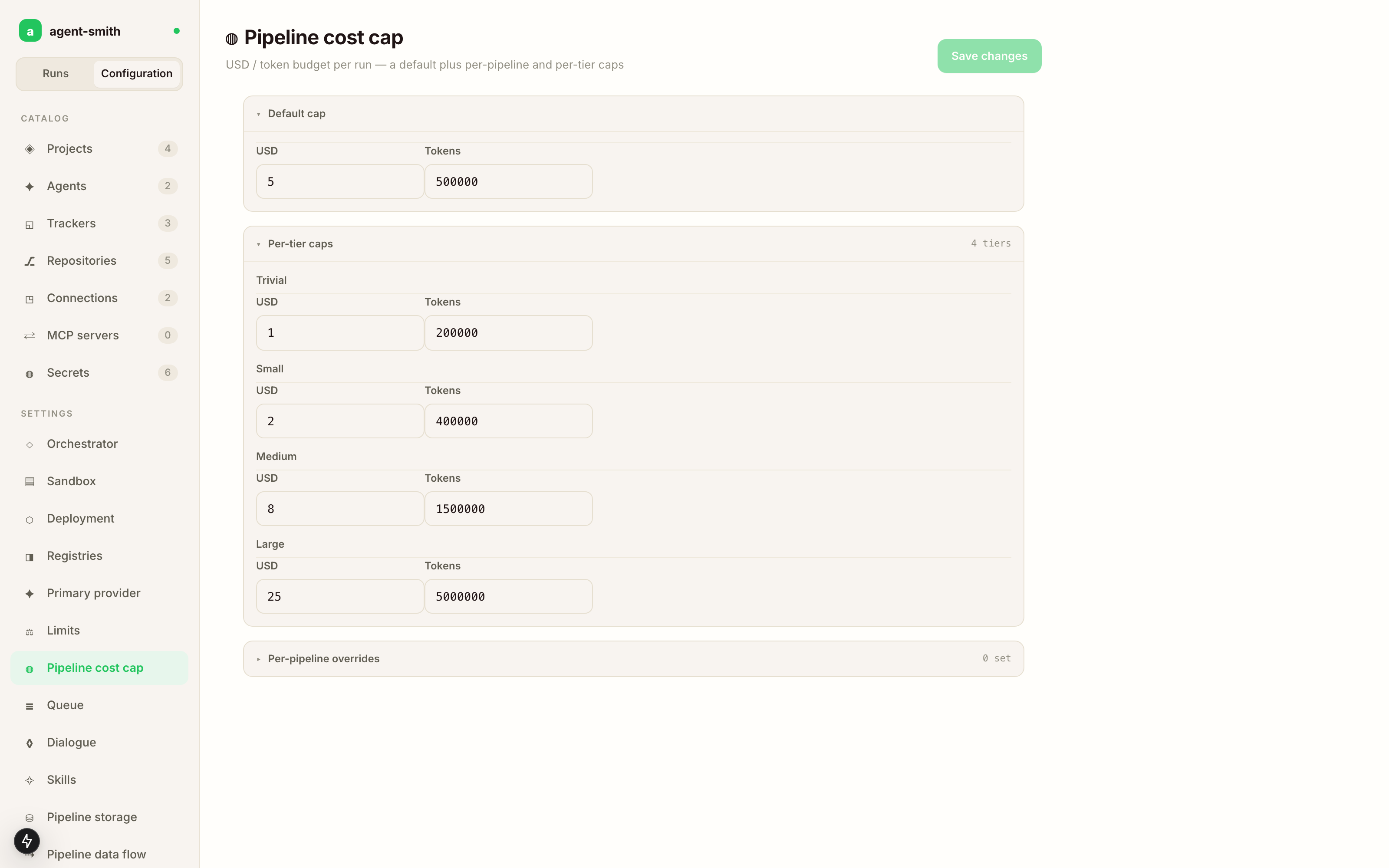
Pipeline cost cap
The money one. A default cap in USD and tokens, four tier caps (trivial, small, medium, large) applied by the estimated size of the work, and optional per pipeline overrides. A run that hits its cap stops and says so.
Queue
Consumer backpressure, and how often the queue retries against Redis.
Dialogue
How long a run waits for you. HotWaitSeconds is the window it holds the sandbox open expecting a fast answer. ApprovalTimeoutSeconds is how long the question stays answerable before the run gives up. The defaults are ten minutes and three days.
The same block carries dashboard_url, your dashboard's address, so the ticket comment that asks a question links to the run's page. Without it the comment carries no link. The form has no field for it; set it through import.
Skills
Where the skill catalog is resolved from. Every release ships with its catalog embedded, so there is nothing to pin here. It exists as an override for skills development and for air gapped mirrors.
Pipeline storage
How long in flight run artifacts stay in Redis.
Pipeline data flow
Whether the data flow gate warns or enforces.
Trace
Whether a run records its conversation (every prompt as sent, every answer, every tool result as the model received it), not only its numbers. Off by default, because a traced run's record grows fast. The AGENTSMITH_TRACE environment variable, when it is set, wins over this switch in both directions, so a deployment that sets it in its manifest keeps what the manifest says. See Recording what the model was told.
What the settings rail leaves out
persistence: is absent on purpose. It's bootstrap only, read from the file before the server can talk to a database, so making it editable in a UI backed by that database would be a circle. Change it in agentsmith.yml and restart.
auth: and tool_runner: are bootstrap as well: the token authority is wired before the database is reachable, and the scanners' runner is built at start. Both stay in the server's own agentsmith.yml. An import doesn't store them and says so, as it does for every other key of the file it doesn't keep.
secrets: is absent because it has its own catalog. The studio holds names, and values stay in the environment.